So, I submitted my first writing submission to a magazine ever--a short story for Weird Tales magazine's website series of "One-Minute Weird Tales."
After about three weeks, I received a polite rejection notice. To my surprise, I felt... great! It was wonderful to know that I'd actually put myself out there and submitted something, and that someone had at least glanced at it long enough to say "no."
For the interested, here is my story:
"Master"
My cat, Schmoopie, had been reading.
Each day after work, I would catch her with a volume of the encyclopedia.
She would stare as I put it back on the shelf.
And the next day, there would be another.
On Monday, it was Delusion - Freon
On Thursday, it was Truffle - Zygote
Yesterday my key wouldn't open the front door.
I could see her little face in the window,
calm, and completely still.
When I went back to the car, it wouldn't start.
I live in the middle of nowhere.
Each morning since, I find bowls of water and cat food on the steps.
I am saving some until there is enough to get me to the next town.
Showing posts with label writing. Show all posts
Showing posts with label writing. Show all posts
Friday, February 12, 2010


Tuesday, November 17, 2009
Review - First We Read, Then We Write
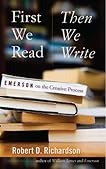 First We Read, Then We Write: Emerson on the Creative Process by Robert D. Richardson
My rating: 2 of 5 stars
I skimmed over this book--it was interesting, but it seemed like the reader had to know and like Emerson in the first place in order to appreciate it. The author is a well-known biographer of Emerson, and I just couldn't share his passion without knowing much about Emerson myself. The ideas in the various chapters seemed a bit disjointed, too, as though the author was grasping for every tidbit from Emerson's journals and letters that might have to do with writing. I was hoping for a more gradual continuum of "this is how reading affects writing." Still, it had a few good points that stood out.
Some quotes I liked: "The way to write is to throw your body at the mark when your arrows are spent" (Emerson)
"There is a time in every man's education when he arrives at the conviction that envy is ignorance; that imitation is suicide; that he must take himself for better or worse as his portion; that though the wide universe is full of good, no kernel of nourishing corn can come to him but through his toil bestowed on that plot of ground which is given him to till. The power that resides in him is new in nature, and none but he knows what that is which he can do, nor does he know until he has tried." (Emerson)
I also got a certain understanding from the idea derived from Emerson's book Representative Men Seven Lectures, that poets (and also writers in general), are representative of the average person, not unreachable hero-people. All artists have some qualities that all people can share. Richardson says that, "This representativeness of great people can fairly be called Emerson's central social and religious teaching." He points out the representativeness of God in the person of Jesus as an example of this phenomenon--Jesus is representative of the suffering of all people, thus we can identify with him. In the same way, a writer mustn't be focused on themselves--they have to have passion for describing the human condition. It is in that way that writers become elevated in people's eyes--not by being above other people, but by laying down their lives for their writing in the belief that there is someone out there who can identify with and benefit from reading them.
View all my reviews
Thursday, October 29, 2009
Review - Old School
 Old School by Tobias Wolff
My rating: 3 of 5 stars
Old School is about a kid at a New England boarding school where they have writing contests. Each year, the winner gets to meet a visiting author (in the book, these include Robert Frost, Ayn Rand, and Ernest Hemingway).
This was an enjoyable book for me since I have an interest in writing--one of the main themes being that writers must not be afraid to expose their true selves in their art. I liked Wolff's weaving of real authors into the story, and especially loved the smackdown he gives to Ayn Rand.
I didn't like the way he presented dialogue without quotations--at first I didn't notice it, but at one point it really confused me as to whether a character was talking or it was just part of the narrative. I can see that maybe that was his point, because it does create an atmosphere of being in the story since the quotations are not distractingly set apart, but it also added confusion. The ending worked, but it was a little meandering too. I felt like I didn't really need to know what happened in the next forty years, and that the parallels between the narrator's experience and that of Dean Makepeace could have been handled in a different way (not that I can suggest one).
View all my reviews
Monday, April 6, 2009
Review - 78 Reasons Why Your Book May Never Be Published and 14 Reasons Why It Just Might
 78 Reasons Why Your Book May Never Be Published and 14 Reasons Why It Just Might by Pat Walsh
rating: 3 of 5 stars
This was a three-star ("liked it") book for me mainly because it didn't suck me in . . . but that is not to say that it isn't a very important book. It's time to take all of the feel-good compliments that the people who love you give about your writing and wake up to the real world.
The number one reason that Pat Walsh, an editor at MacAdam/Cage, gives that your book will never be published is that you have not written it. Talk is cheap, and writing is very difficult.
Throughout the book, Mr. Walsh gives great advice on avoiding the pitfalls of the publishing industry (and the ones that we writers create in our own heads). The most valuable tidbits I got from it are: write as though you are writing to a stranger (if you're constantly worrying about what your family will think of your story, there's no way it will be honest), revise your book before you try to get it published (even if you have to re-write the whole thing), and take yourself and your work seriously (but not so seriously that you think your writing makes you the King of the Universe).
Sometimes negative feedback is the best feedback you can get about your writing, because it's the only feedback that is going to help you improve it. You have to be willing to step back and experience rejection for what it is--an opportunity to do better.
That said, he ends the book on a positive note, saying that no matter how hard writing and getting published is, it is definitely worth it.
View all my reviews.
Subscribe to:
Posts (Atom)

