Wednesday, December 30, 2009

Review - The Sailor Who Fell from Grace with the Sea

The Sailor Who Fell from Grace with the Sea The Sailor Who Fell from Grace with the Sea by Yukio Mishima


My rating: 1 of 5 stars

Mishima is clearly a brilliant writer--his prose (at least, the English translation of it), puts you right in the situation. Unfortunately, this is part of the problem for me, for as well as a brilliant writer he was a profoundly disturbed man (he eventually committed seppuku, Japanese ritual suicide).

The book is, loosely, about a sailor who turns his back on dreams of glory on the sea to love a woman, and how that relationship and the world is seen by the woman's son, Noboru. Noboru is part of a gang of boys who see the world as useless, and killing, or rather the ability to end life, as the ultimate proof of their superiority over the world.

Disturbing stories used to not bother me like they do now, and I just couldn't finish this. It had an interesting concept and beautiful writing, but I had to draw the line at the kitten-killing.

View all my reviews

Review - Pickets and Dead Men: Seasons on Rainier

Pickets and Dead Men: Seasons on Rainier Pickets and Dead Men: Seasons on Rainier by Bree Loewen


My rating: 4 of 5 stars

A fascinating book about Bree Loewen's experiences over three years as a climbing ranger on Mt. Rainier. Those rangers face an incredibly tough life, and I don't blame her for quitting. Not the life for me, thanks, except maybe for the copious amounts of macaroni and cheese that Bree eats throughout the book.

View all my reviews

Wednesday, November 25, 2009

At Last

Finally, finally, I'm seeing the light. The MLIS program I'm in requires 4 core courses and 8 electives. On December 17th, I'll complete the last of the core requirements with one elective under my belt t'boot! 5/12 of the way through the program... almost halfway done.

When I started this, I didn't expect the degree to take me this long. I didn't expect a lot of things to happen--people dying, pets dying, getting married, buying a house. This is technically my third year in the program, and it's going to run at least another year and a half before I can complete it.

This semester has been going better now that I have taken to heart the advice that I don't need to get straight A's. There are things that are more important than school (gasp!) It's been working well for me... less stress, less time spent on it, and I'm still averaging over a B.

And now I get to take whatever classes I want for the rest of the program! Woot!

Yesterday I signed up for Spring semester--taking "Genealogy I & II" and "Information Resources for the Health Sciences." The Genealogy series is two back-to-back one credit courses which end in April, so they will overlap with the other three credit course for the first three months, then leave me a month of breathing room to finish up finals for the second course in May.

It is exciting and sad that for the first time, I am truly looking forward to my graduate classes.

Sunday, November 22, 2009

Review - Girl, Interrupted

Girl, Interrupted Girl, Interrupted by Susanna Kaysen

My rating: 1 of 5 stars

I only got about half-way through this book... it was useful to me to look at the form the author chose, but since I have a brother-in-law in a mental hospital, I couldn't exactly agree with the reviewer quote on the cover that it was "triumphantly funny." I think she was probably missing the point. It made me feel less amused and more like I was going to vomit.

View all my reviews

Saturday, November 21, 2009

Review - Cordelia's Honor

Cordelia's Honor (Vorkosigan Omnibus, #1) Cordelia's Honor by Lois McMaster Bujold

My rating: 4 of 5 stars

I haven't read much recently-written science fiction other than Star Trek and Star Wars-related stuff in my reading career, so I decided to give this a try on the recommendation of a friend. I was not disappointed. Flawed, yet amazing characters, well-realized worlds, a plausible far-future, witty, and lots of explosions and righteous slaying t'boot. Some parts got a little slow, but when I picked the book back up I was quickly hooked again. Can't stand the back of the book, though... it tells you the whole story. Basically, it's about Cordelia, and she's awesome. And you should read it. Enough said.

View all my reviews

Deaf American Poetry: An Anthology

I picked up this poetry book at the library (edited by John Lee Clark, Gallaudet University Press, 2009). Through the words of 35 deaf American poets, it conveys what it was like to be deaf over the past couple of centuries in American history. The first poets tend to be negative toward themselves, but they gradually become more self-affirming, with an angry or melancholy poem here and there. I want to post some of my favorites from the book. Some of the poems moved me nearly to tears, and overall they gave me a much greater appreciation for the deaf identity as a culture--particularly in ASL as a heart-felt mother tongue and in the ability to be completely fulfilled and whole despite the larger culture's assumption that one is "disabled" or "lacking something." I'm sure these first two are in the public domain, but correct me if I'm wrong:

To a Bride
Mary Toles Peet (1879)

Thou askest, O my friend, a song to-day;
But what soft note, what subtle melody
Can thy young heart's delicious joy convey?

In Life's enchanted lyre, one chord alone
Can thrill thee with a music all its own,
And fill thine heart with one most perfect tone.

What need, then, hast thou that I sing to thee?
June roses for thy bridal, fair to see,
Are sweeter music than my notes can be;

And song-birds flitting thro' the fragrant air,
And stars that gleam, like living eyes, from where
Thine own turn softly in thy troth-plight prayer.

Then silence, sweeter than all varied sound,
Shall fold thee soft, like loving arms around,
For life's most perfect gift thy heart hath found.


A Prayer in Signs
Alice Cornelia Jennings (before 1900)

No uttered word is ours--no solemn tone
The reverent air bears upward to the sky
No eloquence of meaning, borne along
Of voice and accent, meet the God on high.

But dare ye tell us that we do not pray--
We who so truly "lift up hands of prayer,"
And by the speaking gesture mark the way,
Our heart's desire would take to reach Him there?

"Our Father!" that appealing gesture lifts
With force more potent than the spoken word,
Desire, petition for the precious gift
Held in the hand of One All-Seeing Lord.

"In Heaven!" we picture in the circling sweep
Of arm and hand, the glorious dome above;
"Holy Thy Name!" with reverent movement keep
The sacred thought of purity and love.

"Thy Kingdom!" with imperial touch we show
The badge of royalty--the sceptre's sway;
And that Thy glorious Will may work and grow
Potent and perfect, this and every day.

Our opened hands with daily bread to fill
The Lord we ask, "Forgive as we forgive":
O hearing brothers! we are like you still--
The hardest this to pray, and this to live.

From tempter's touch, whene'er beside he stands--
We pray thee still our weakness to defend:
And by the symbol strong of broken bands
We crave deliverance, succor, to the end.

Once more the royal sign--"Thy Kingdom Thine!"
"The Power," that sign is vital, living, strong:
"The Glory": rays of brightness seem to shine
And scintillate around us, sweet and long.

"Forever and forever!" round and round
The finger sweeps, and who shall tell us then
Expression for the prayer we have not found,
Nor join us in our glad and grand "Amen"?


I am less sure about the copyright status of this one, so I will only post the last three stanzas. It's by a poet who eventually committed suicide. Beautiful, but profoundly sad.

from "I Will Take My Dreams . . ." by Felix Kowalewski

I will stand with my dreams on the top of the highest mountain;
I will brush from my hands the dust of their tears.
I will stride to the edge of the abyss before me--
The yawning abyss of dreamless years.

I will seize my dreams on the top of the highest mountain;
And then, in despair, I will fling them down!
I will see them fall, to burst in a thousand fragments
--The fairies, the music, the lovely lady's crown!

I will sit me down on the top of the highest mountain.
I will stare at the lonely waste of rock and sky.
I will lay me down at the edge of the abyss.
I will dream no more; and dreamless, I shall die.

And, part of Kowalewski's friend Loy E. Golladay's reply to his poem (obviously wasn't too happy that his friend chose to kill himself, nor agreeing with his despairing worldview):

from "Surely the Phoenix"

... You who have hurled your dreams from the highest mountain,
And watched their splintering crash to the ground;
Did you see all the stars that were torn from their courses?
Surely the universe shook at the sound!

...

Nothing begins where nothing ended,
All things enter whence all things fly;
Surely the dreams go on forever--
Only the dreamers die.

Die, then they cast away their dreaming,
When they scorn the grain in the search for chaff.
Then Death sits back in his gloomy cavern
To laugh . . . and laugh . . . and laugh.


Aaaand, on that happy note... I'm just putting off homework, so I'll go do my studently duty.
Tuesday, November 17, 2009

Take it Apart

It's a famous proverbial situation in the field of library science--is it ethical to make available information on how to build or use nuclear weapons? My husband pointed out that even if a library buys books on how to build a nuclear weapon, it's extremely unlikely that anyone could afford the parts.

I have never gotten a question about this at the reference desk, but the other day I was walking by it when I heard a patron in the middle of asking about how to disassemble nuclear weapons. I didn't get a chance to hear the answer, but he would have made the mayor of Hiroshima proud.

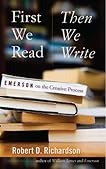
Review - First We Read, Then We Write

First We Read, Then We Write: Emerson on the Creative Process First We Read, Then We Write: Emerson on the Creative Process by Robert D. Richardson

My rating: 2 of 5 stars

I skimmed over this book--it was interesting, but it seemed like the reader had to know and like Emerson in the first place in order to appreciate it. The author is a well-known biographer of Emerson, and I just couldn't share his passion without knowing much about Emerson myself. The ideas in the various chapters seemed a bit disjointed, too, as though the author was grasping for every tidbit from Emerson's journals and letters that might have to do with writing. I was hoping for a more gradual continuum of "this is how reading affects writing." Still, it had a few good points that stood out.

Some quotes I liked: "The way to write is to throw your body at the mark when your arrows are spent" (Emerson)

"There is a time in every man's education when he arrives at the conviction that envy is ignorance; that imitation is suicide; that he must take himself for better or worse as his portion; that though the wide universe is full of good, no kernel of nourishing corn can come to him but through his toil bestowed on that plot of ground which is given him to till. The power that resides in him is new in nature, and none but he knows what that is which he can do, nor does he know until he has tried." (Emerson)

I also got a certain understanding from the idea derived from Emerson's book Representative Men Seven Lectures, that poets (and also writers in general), are representative of the average person, not unreachable hero-people. All artists have some qualities that all people can share. Richardson says that, "This representativeness of great people can fairly be called Emerson's central social and religious teaching." He points out the representativeness of God in the person of Jesus as an example of this phenomenon--Jesus is representative of the suffering of all people, thus we can identify with him. In the same way, a writer mustn't be focused on themselves--they have to have passion for describing the human condition. It is in that way that writers become elevated in people's eyes--not by being above other people, but by laying down their lives for their writing in the belief that there is someone out there who can identify with and benefit from reading them.

View all my reviews

Monday, November 2, 2009

Compact Shelving

From the school that I "go" to but have actually never been to...

Thursday, October 29, 2009

Review - Old School

Old School Old School by Tobias Wolff

My rating: 3 of 5 stars

Old School is about a kid at a New England boarding school where they have writing contests. Each year, the winner gets to meet a visiting author (in the book, these include Robert Frost, Ayn Rand, and Ernest Hemingway).

This was an enjoyable book for me since I have an interest in writing--one of the main themes being that writers must not be afraid to expose their true selves in their art. I liked Wolff's weaving of real authors into the story, and especially loved the smackdown he gives to Ayn Rand.

I didn't like the way he presented dialogue without quotations--at first I didn't notice it, but at one point it really confused me as to whether a character was talking or it was just part of the narrative. I can see that maybe that was his point, because it does create an atmosphere of being in the story since the quotations are not distractingly set apart, but it also added confusion. The ending worked, but it was a little meandering too. I felt like I didn't really need to know what happened in the next forty years, and that the parallels between the narrator's experience and that of Dean Makepeace could have been handled in a different way (not that I can suggest one).

View all my reviews

Saturday, October 24, 2009

BookCrossing

Several months ago after my husband and I moved to the small town of Lynden, WA with its Dutch heritage, and we soon requested a visit from the Welkom basket lady. Clothed in traditional Dutch garb, she came knocking at our door one Saturday morning with a basket full of goodies and coupons for a variety of free stuff and discounts on services.

Today we finally went around town and loaded up on a bunch of the free goods. Afterward, we headed home, then walked about a block to a nearby Greek restaurant. Now, I know this is terrible, but I'm not in the habit of washing my hands before I eat at a restaurant. My husband leads by example, though, so after he had headed off and returned again, I too made my voyage to the restroom thinking it was probably a good habit to pick up.

There, leaning against the mirror, I found a most intriguing and peculiar thing--a book with a "FREE BOOK" sticker on it. It was a horror novel about a dead ex-husband, and coming up on my first anniversary not something I particularly wanted to read. However, the web address on the front and the book ID number inside were enough to get me to pick it up and take it home with me.

Through it I have discovered BookCrossing: a free online community where you can register your books and either "release" them "into the wild" or give them a "controlled release" to someone you know. You can even search for books that have been released nearby and go "hunt" them--a very exciting and nerdy sport, somewhat reminiscent of Geohashing. I've seen through the BookCrossing website that there are also other such sports, like Postcrossing.

In fact, now I understand something from the last book I read, The Eyre Affair. There is a group of people in it called the Earthcrossers, who gather together whenever there is a meteor shower and attempt to catch meteorites in special mitts. At least now I sort of get what the author was parodying.

Anyway, this has the potential to be fun, and it is a neat way to get rid of books that you can't sell. I'm planning on BookCrossing five or six of them some time soon... let me know if you want one and I will mail it to you to spread the awesomeness. They are:

Shadowfires, Dean Koontz
The Woad to Wuin, Peter David
The Eyre Affair, Jasper Fforde
Many Dimensions, Charles Williams
Waters Luminous and Deep, Meredith Ann Pierce
Persepolis, Marjane Satrapi
Random House Japanese-English English-Japanese Dictionary, Seigo Nakao

Thursday, October 22, 2009

Book Titles Weird and Monotonous

Another link courtesy of American Libraries Direct: the Weird Books Room on AbeBooks!

Some of my favorites from this selection:
Why Do I Vomit?
Soldier Bear
(you have to see the cover)
What to Do When the Russians Come: A Survivor's Guide
Oedipus in Disneyland
Is Your Dog Gay?
Poop-Eaters: Dung Beetles in the Food Chain
Nuclear War: What's in It for You?
How to Survive a Robot Uprising
The Bible Cure for Irritable Bowel Syndrome

Lately I've also noticed an increasingly annoying phenomenon in trendy scholarly book titles. We're an academic library, so of course we buy a lot of academic books, and it's become obvious to me that the format Trendy Title: A Trendy Subtitle That Explains What the Trendy Title is Actually About is very popular. I would vote for an even more original trendy title that can fit in one line and can also adequately represent what the book is about. Here are some examples of what I mean from the recent batch of books that we ordered:

Guesstimation: Solving the World's Problems on the Back of a Cocktail Napkin
World Without End?: Environmental Disaster and the Collapse of Empires
The Sea Woman: Sedna in Inuit Shamanism and Art in the Eastern Arctic
The Borders Within: Encounters Between Mexico and the U.S.
Al'America: Travels Through America's Arab and Islamic Roots

There are SO many of these that whenever I see one I just want to shake the author, or the publisher, or whoever is responsible for it and say "We get it already! The trendy title is very clever! Can you just tell us what the book is about instead?"

I guess I'm stuck with book titles in this line of work, from the amusing to the downright obnoxious.

Wednesday, October 21, 2009

Terrible Book Title

I just ordered a book called Harpoon: Into the Heart of Whaling.

Let the bad puns roll.

Review - The Eyre Affair

The Eyre Affair (Thursday Next, #1) The Eyre Affair by Jasper Fforde

My rating: 4 of 5 stars

This was a very fun, genre-defying book... a little bit of science fiction, alternate history, fantasy, horror, time travel, historical fiction, romance, literary parody... it's pretty much got it all, and it blends them well.

Thursday Next is a LiteraTec in an alternate 1985 UK, except that it's not the UK since Wales is an independent and somewhat hostile state. Everyone is nuts about classic literature, so LiteraTecs exist to combat literary crime. There are over two dozen other special operations units with various functions, and with whom Next comes into contact frequently throughout the book. Her father is a renegade member of SpecOps-12, the ChronoGuard. Next finds herself pitted against a heinous villain, fumbling around a long-lost love, traveling through time, shooting people and getting shot, among other things. I won't spoil the other things like the back of the book does (OMG DON'T READ THE BACK OF THE BOOK WHATEVER YOU DO IT RUINS THE FIRST 200 PAGES).

Despite that annoyance and some obnoxious writing pet peeves (occasional dialogue in which you can't tell who's talking, etc.), it's a very entertaining read. I think there are something like five more in the series now, and I would consider picking up more of them at a later date.

View all my reviews

Tuesday, October 13, 2009

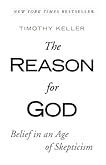
Review - The Reason for God

The Reason for God The Reason for God by Timothy Keller

My rating: 5 of 5 stars

This is the first book I've read in a long time, possibly even the first book ever, that is a well-reasoned, intellectually satisfying argument for the existence of God and his divinity in Jesus Christ.

One of the things I like most about Keller's writing is that he comes across as a down-to-earth person who obviously has great respect and patience for people's questions. Not having grown up a Christian, I have often had great difficulty relating to people who speak "Christianese" and justify faith using only the Bible, but Keller's arguments put God and Jesus in a rational, scientific, and historical context. He frames the book in two sections: confronting doubts about Christianity (scientific, cultural, Biblical, historical, etc.) and analyzing the foundations of its claims (particularly about Jesus).

The book comes down to a conclusion that I've heard in many other places--Jesus wasn't just an enlightened teacher. If you read everything he says in the Bible, you will quickly conclude that either he was the son of God . . . or he was a stark raving nutcase. But it's one or the other.

I want to summarize parts of the book here, but I would have to water it down too much for a small post, and I don't think I could do it justice. If I had to recommend one book, though, that sums up all of the reasons why I am a Christian, why my doubts six years ago were not enough to keep me from becoming one, and why, though I continue to struggle with faith, I keep coming back to Christ, it would be this one.

You won't find any irrefutable proof of God in this book (or in life, for that matter), but Keller makes an excellent, gently stated argument.

View all my reviews

Monday, October 5, 2009

Library Pet Peeves

Okay, I'm trying to think of some other material to post here other than my Goodreads reviews (although I know some of you don't look at my Goodreads account, so the cross-posting is still useful).

Library pet peeves. Well, really only one is a "library" pet peeve, I suppose.

Newspapers. I can't stand it when people don't put the newspapers back neatly. It is not hard to put the other sections back into the "A" section. I don't care if they're in order, as long as it looks like a whole paper and the front page is the first thing I see. I suppose there could be four people every day who have to rush off to the hospital to tend their ailing great-uncles and can't be bothered to take the five seconds to put the paper back correctly... and if so, I can forgive that. But come on. Otherwise it's just laziness.

I also can't take it when people take their stuff out of the microwave before the time is up, then they don't clear the display. I look at the microwave all the time in order to find out what time it is, and 05 is not a time. It drives me nuts.

But you know... at least I still have two legs and two hands and two eyes, so I can walk around and grab books and read them. That is always a good thing.

Review - Many Dimensions

Many Dimensions Many Dimensions by Charles Walter Stansby Williams

My rating: 3 of 5 stars

Charles Williams was a contemporary of Lewis and Tolkien, and a member of the Inklings. His stories also deal with the fantastic, but they tend to take place in our world and have spiritual or ethical themes.

Many Dimensions is about a mysterious stone that has been wrongfully taken from the Persian Empire and is said to have belonged to King Suleiman (Solomon) in ancient times.

Lord Arglay, the Chief Justice of Britain, and his secretary Chloe Burnett try to understand the powers of the stone as they act to prevent its use for the wrong reasons.

The stone seems to be a metaphor for God in the story, but also for power in general--how different people seek to use and misuse it. Ultimately, only those who are willing not to use it for themselves at all, but to submit to its own unknown purposes are able to fully experience it.

I can't say I really "got" or liked the ending as much, but the writing was rich and interesting and the philosophical themes challenging. As much as I liked the theme, though, I felt like the story served too much as a vehicle for it and would have liked it to be more integrated.

View all my reviews

Tuesday, August 11, 2009

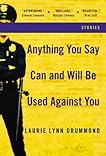
Review - Anything You Say Can and Will Be Used Against You

Anything You Say Can and Will Be Used Against You: Stories Anything You Say Can and Will Be Used Against You: Stories by Laurie Lynn Drummond

My rating: 4 of 5 stars

Delve into the brutal and contradictory world of these five female police officers, and you will find yourself simultaneously sympathetic and disturbed. Learn what life is like when your job is to help people in the most extreme situations and to be the first on the scenes of some of the most grisly crimes.

This kind of life can both save people and destroy relationships, and I found myself identifying with at least one thing about each of the main characters in these short stories. I wouldn't recommend reading it when you're already feeling upset about something, though--it is not light fare; it does not pull any punches.

View all my reviews

Thursday, July 23, 2009

Review - The Princess and the Goblin

The Princess and the Goblin (Puffin Classics - the Essential Collection) The Princess and the Goblin by George MacDonald

My rating: 4 of 5 stars

This was really an enjoyable read. George MacDonald was a fantasy writer and minister who lived from 1824-1905. To put his work into perspective, he followed closely on the heels of Hans Christian Andersen and helped to convince Lewis Carroll to publish his Alice stories. Although he is not as well known now, he also served as an inspiration for the next generation of fantasy writers (Lewis, Tolkien, L'Engle)--part of the sort of bridge between true fairy tales and the fantasy genre as we know it today.

In The Princess and the Goblin, the Princess Irene aids the miner boy Curdie in uncovering and foiling a wicked plot by the underground-dwelling goblins. A simple story, but beautifully written and full of magic.

As MacDonald was a Christian minister, his faith does imbue his stories with a sense of spirituality, but I found it to be more subtle than in Lewis' Narnia stories. The two children are aided by Princess Irene's mysterious great great grandmother, who can only be seen by those who believe she is there. Lots of connections to God in this character, particularly in the following touching scene:

The princess was so bewildered with astonishment and admiration that she could hardly thank her, and drew nigh with timidity, feeling dirty and uncomfortable. The lady was seated on a low chair by the side of the fire, with hands outstretched to take her, but the princess hung back with a troubled smile.

'Why, what's the matter?' asked her grandmother. 'You haven't been doing anything wrong—I know that by your face, though it is rather miserable. What's the matter, my dear?'

And she still held out her arms.

'Dear grandmother,' said Irene, 'I'm not so sure that I haven't done something wrong. I ought to have run up to you at once when the long-legged cat came in at the window, instead of running out on the mountain and making myself such a fright.'

'You were taken by surprise, my child, and you are not so likely to do it again. It is when people do wrong things wilfully that they are the more likely to do them again. Come.'

And still she held out her arms.

'But, grandmother, you're so beautiful and grand with your crown on; and I am so dirty with mud and rain! I should quite spoil your beautiful blue dress.'

With a merry little laugh the lady sprung from her chair, more lightly far than Irene herself could, caught the child to her bosom, and, kissing the tear-stained face over and over, sat down with her in her lap.

'Oh, grandmother! You'll make yourself such a mess!' cried Irene, clinging to her.

'You darling! do you think I care more for my dress than for my little girl?'


Anyway, wonderful story. You can read it online for free at Project Gutenberg--here is a direct link. They also have most of MacDonald's other stories since they are in the public domain. The book is followed by a sequel, The Princess and Curdie. Incidentally, there was also an animated movie of The Princess and the Goblin from 1992. I don't think I ever saw it since it looked pretty cheesy, but now I am intrigued to know whether it follows the book.

View all my reviews

Saturday, July 18, 2009

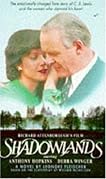
Review - Shadowlands

Shadowlands Shadowlands by Leonore Fleischer

My rating: 4 of 5 stars

To tell you the truth, I didn't expect much from a book that is a novel "based on the screenplay by William Nicholson based on his stage play." However, I was pleasantly surprised by the . . . joy of reading it! A few editing issues--a repeated paragraph here and there, etc. Other than that, however, the writing was smooth and vivid.

This book is based on the true story of C.S. Lewis' romance and marriage with Joy Davidman Gresham. Lewis, in his fifties and settled into the life of a university teacher and bachelor, thought that he knew what love was--until he realized, thanks to Joy, that he had been putting up walls to keep his feelings in and people out ever since his mother died when he was nine years old. Through his marriage to Joy, C.S. Lewis came alive again and was finally able to understand the wonder and the suffering that he had been lecturing about for so long.

Lewis' story resonated with me, as I have also been through a lot of pain in my life and a lot of effort to protect myself from it. Person by person and book by book, I catch glimpses of freedom through the holes in my own walls, making joyful connections to the other side. For, as the father of one of Lewis' students is reported in this story to have said, "We read to know that we're not alone."


View all my reviews

Tuesday, July 14, 2009

Review - C.S. Lewis: A Celebration of His Early Life

C.S. Lewis: A Celebration of His Early Life C.S. Lewis: A Celebration of His Early Life by Ruth James Cording

My rating: 3 of 5 stars

An enjoyable book, if a bit misrepresented, C.S. Lewis: A Celebration of His Early Life is a quick read in a cute coffee table format.

I say misrepresented because the last five of the sixteen chapters in the book focus on his mid-twenties and beyond. Maybe I don't think of the mid-twenties as "early life" since I'm only twenty-five myself, but I would have liked to know more about Lewis' childhood, and in a format that had more continuity than this collection of anecdotes.

It also would have been more readable if the included letters would have been placed at the ends of chapters instead of right smack in the middle of the main narrative. In addition, I spotted a few sentence fragments. Which I found to be quite eye-stabbing. While I was reading.

Despite these complaints, I did find it to be quite a sentimental and aesthetically pleasing little volume. Good brain candy for fans of Lewis and those who long for the wonder in life.

View all my reviews

Sunday, July 12, 2009

Review - The Career Mystique: Cracks in the American Dream

The Career Mystique: Cracks in the American Dream The Career Mystique: Cracks in the American Dream by Phyllis Moen

rating: 5 of 5 stars

Wow, this one took me a while. It's not often that I read books of a more academic persuasion straight through, but I found this on the library shelf while moving books at work, and it sucked me into its vortex.

The premise is that the American Dream is an illusion, but even that doesn't sum up the full complexity of this work. In 1963, there was Betty Friedan's The Feminine Mystique, which gave voice to women's "problem with no name"--that they were expected to be full-time wives and homemakers with no option to be anything else.

Now, our society has developed the "career mystique" of the title--that anyone and everyone can follow the "lock-step" pattern of education, full-time employment, and subsequently leisure-filled retirement. The folly of this is that being able to work full-time depends on having someone to take care of domestic duties. Is the problem becoming clear?

The authors elaborate:

...jobs remain designed as if employees were able and willing to focus exclusively on them. Jobs, schools, medical services, and many other aspects of contemporary life continue to assume that someone (a wife) is available during the typical workday to care for children ... to have the refrigerator fixed or the new stove delivered; to engage in the civic activities that build communities. But the wives who facilitated men's careers now have careers of their own, as do the sisters, mothers, grandmothers, friends, and neighbors that working women relied on as backup in the past. p.190

This is not to say that we should go back to the breadwinner/homemaker model, rather that the way American working society functions has not caught up with contemporary reality. This has severe consequences for the very poor, for healthy family lives, and for the future of our population. Some quotes:

Risks of poverty associated with single parenthood are now exacerbated by welfare reforms that assume that (1) jobs are available to low-skilled people, and (2) such jobs pay enough for people to work their way out of poverty. p.192

Time has become a scarce commodity in American life. This is especially problematic given the equating of work time with work commitment and employers' expectations of high commitment. As a fixed commodity, time allocated to employment is necessarily unavailable for other activities, including family relations. When all adults in families are paid employees, the family gains in income. Employees themselves may experience a sense of productive engagement and self-esteem. What is lost when everyone is earning a living is time for living. (emphasis added) p.192

Today, even in educated households, taking time out of the labor force or working a reduced schedule to raise young children, to care for aging parents, or simply to have a saner lifestyle can wreak havoc on seniority, salary, security, retirement income, and possibilities for promotion. Many workers try to solve the dilemmas of managing job, family, and personal life by controlling what is in their control: by delaying childbearing, having fewer children, or having none at all. This is a key point: Advanced nations, including the United States, are experiencing record lows in fertility precisely because most women and men want or need to be productively engaged in the workforce, and neither men nor women can figure out how to synchronize family-care work and paid work. p.194

The solution the authors suggest is that the United States must rise to the challenge of creating "integrative, flexible careers--occupational paths that acknowledge rather than ignore personal and family goals and obligations, (re)educational goals and needs throughout adulthood, and midcourse inclinations for second acts, including postretirement and civic engagement." p.199

This book was a challenge to me and I hope that its premises become a challenge to our entire country. The authors predict that, in a characteristically human way, we will not change the system until crisis necessitates it. I, for one, hope that they are proven wrong. Workers need to be respected regardless of gender and given society's blessing to pursue whatever life choices they wish--whether it's to do family-care work, paid work part-time, paid work full-time, or a mix of those at different periods of their lives. We are people who love our families and need time to rest--not antisocial robots who can dedicate our full attention and life servitude to a corporation or institution.

As individuals, we can do what is possible to focus on our loved ones rather than our jobs, but not all of us are guilty of pursuing stuff we don't need--some of us need to work like crazy just to get by. This is why some of the changes need to happen on the corporate level, where income is not keeping up with rising costs of living, and the government level, where dysfunctional programs foist unrealistic expectations on what single parents with little education can do to pull themselves and their children out of poverty. On a personal level, couples should not have to choose between both having a secure career on the one hand and the destruction of their relationships on the other.

There is anger here, and a call to action. Let's all hope that action won't be too late.


View all my reviews.

Wednesday, July 8, 2009

1947

This is odd... it kind of seems like librarians haven't changed that much since 1947, aside from the technology aspect. And the director being a man with an army of women to command.

Tuesday, June 23, 2009

Review - 7 Steps to a Pain-Free Life

7 Steps to a Pain-Free Life: How to Rapidly Relieve Back and Neck Pain 7 Steps to a Pain-Free Life: How to Rapidly Relieve Back and Neck Pain by Robin McKenzie

rating: 3 of 5 stars
The writing was pretty redundant and every case study had the annoying style of a blaring advertisement, but the exercises really work. Get this book and you too can be pain-free!


View all my reviews.

Tuesday, June 16, 2009

Review - Sister Carrie

Sister Carrie: The Unexpurgated Edition (Penguin Classics) Sister Carrie: The Unexpurgated Edition by Theodore Dreiser

rating: 3 of 5 stars

Sister Carrie, written at the turn of the 20th century and considered one of the "great American novels," also has an infamous history of censorship which is fascinating in its own right. I chose to read the free online version of the restored Pennsylvania edition. I understand that the "unexpurgated edition" is based off of that one.

On the surface, the novel is the story of Caroline Meeber, who moves from rural Wisconsin to Chicago in hopes of seeking her fortune. Unhappy with her work prospects due to her lack of experience and the less-than-enthusiastic welcome she gets from her sister and brother-in-law, Carrie is tempted away from a hand-to-mouth existence by Charles Drouet, a traveling salesman who buys her nice clothes and gets her to live with him. Eventually she realizes the shallowness of Drouet's personality and casts in her lot with George Hurstwood, a (unbeknownst to her) married man. This sets them on a path that leads to Carrie's stardom as an actress and Hurstwood's very steep downfall.

The book is dense and not easy to get through, but in the end I did like it. There are two things in particular that I noticed:

1. It is a major commentary on American society. Our society is based around the idea that if we could just have more money, fame, a different lover, or a bigger place to live, we would be happier. Ultimately, Carrie is not happy with her money and fame, and chasing her eventually leads Hurstwood to indifference and suicide. Drouet continues to be his oblivious self, but arguably he is never satisfied either--he can never have meaningful relationships with anyone. This passage in Chapter 49 in which Carrie is talking with Bob Ames, a cousin of her friend Mrs. Vance, sums up this thesis:


"Your happiness is within yourself wholly if you will only believe it," he went on. "When I was quite young I felt as if I were ill-used because other boys were dressed better than I was, were more sprightly with the girls than I, and I grieved and grieved, but now I'm over that. I have found out that everyone is more or less dissatisfied. No one has exactly what his heart wishes."

"Not anybody?" she asked.

"No," he said.

Carrie looked wistfully away.

"It comes down to this," he went on. "If you have powers, cultivate them. The work of doing it will bring you as much satisfaction as you will ever get. The huzzas of the public don't mean anything. That's the aftermath--you've been paid and satisfied if you are not selfish and greedy long before that reaches you."


2. It is not necessarily a work about morality. The author, Dreiser, does mention evil in it, but his characters are not deliberately evil--they suffer because they are driven by their whims and lack understanding of what their actions do to those around them. One might argue anyway that this is a better definition of sin than the overly simplistic list of "lying/cheating/stealing." But I still don't think Dreiser was trying to teach morality in this story--just depict in a naturalistic way that people tend to do what's in their own best interests and that "fate" can lead them in different directions. He sums this up in a rather heavy-handed passage:


Many individuals are so constituted that their only thought is to obtain pleasure and shun responsibility. They would like, butterfly-like, to wing forever in a summer garden, flitting from flower to flower, and sipping honey for their sole delight. They have no feeling that any result which might flow from their action should concern them. They have no conception of the necessity of a well-organized society wherein all shall accept a certain quota of responsibility and all realize a reasonable amount of happiness. They think only of themselves because they have not yet been taught to think of society. For them pain and necessity are the great taskmasters. Laws are but the fences which circumscribe the sphere of their operations. When, after error, pain falls as a lash, they do not comprehend that their suffering is due to misbehavior. Many such an individual is so lashed by necessity and law that he falls fainting to the ground, dies hungry in the gutter or rotting in the jail and it never once flashes across his mind that he has been lashed only in so far as he has persisted in attempting to trespass the boundaries which necessity sets. A prisoner of fate, held enchained for his own delight, he does not know that the walls are tall, that the sentinels of life are forever pacing, musket in hand. He cannot perceive that all joy is within and not without. He must be for scaling the bounds of society, for overpowering the sentinel. When we hear the cries of the individual strung up by the thumbs, when we hear the ominous shot which marks the end of another victim who has thought to break loose, we may be sure that in another instance life has been misunderstood--we may be sure that society has been struggled against until death alone would stop the individual from contention and evil.


From what I hear, the original edited edition of the book removed most of the philosophy from it, made Carrie a mindless, untalented fool, and removed most of the sexual references (which I had trouble detecting anyway, but I guess by early 20th century standards they would have been blatant). Carrie doesn't fret over moving in with Drouet, Drouet doesn't pursue other ladies while living with her, and Hurstwood doesn't frequent prostitutes before he leaves his wife. In other words, the characters were significantly changed.

I enjoyed this book for the depth and the tragedy of it, but it was a very heavy read. I can see after reading the historical notes included on the website that the restored edition is superior to what was originally published and probably closer to what Dreiser intended, although I would have switched the final two chapters--49 reads like an ending, and 50 like an afterthought.

And now, my only remaining question is... whatever happened to Carrie's parents? She goes to live with her sister in Chicago, but I don't remember the book even once mentioning her contacting her parents, thinking about them, or what they thought of her leaving. In fact, I don't think it mentions her parents at all. Either she had an awful relationship with them, or she was just so self-absorbed that she didn't care if her mother was worried sick about her.


View all my reviews.

Monday, May 25, 2009

Review - Birth: The Surprising History of How We Are Born

Birth: The Surprising History of How We Are Born Birth: The Surprising History of How We Are Born by Tina Cassidy

rating: 3 of 5 stars

When I first saw this book and wanted to read it, I thought it would probably strip me of any desire ever to have children. Fortunately, it actually accomplished the opposite, affirming that no matter which way you prefer to give birth--with drugs, without drugs, squatting, lying down, with a midwife or a doctor--there is probably someone out there who has tried it before and there are lots of arguments for your preferred method.

I could detect the author's bias toward giving birth the natural way with a midwife, and frankly felt convinced by it. It seems that our history of treating birth "like a disease" rather than a natural process and interfering with all sorts of drugs, tools, and doctors who think they know better than women who have been through it has caused more harm than good.

The mini-biographies of all kinds of natural birth advocates have me convinced that if my husband and I ever have a baby, which I hope we will in a few years, I would want to try it the natural way. Pain is manageable without drugs and it sounds like there are less risks overall (for example: the numbness of an epidural can take away a woman's ability to push, thus increasing the risk of breech babies, a required C-section, or the use of forceps and episiotomies. Babies can be accidentally cut during C-sections, and those operations also increase the future risk of pregnancy complications or infertility since a placenta has difficulty attaching to scar tissue).

My main criticism of the book is that it's so packed with information that could have been better organized by time period. The author chose to organize it by category, which worked well for such an ambitious project, but the times jumped around so much that it was a little hard to follow at points. Other than that, I loved the stream of factoids and constantly interrupted my husband's own reading to share them with him.

Being informed about something always makes me much more calm about it than not knowing, so the positive impact of reading this book overall far outweighed the gruesome parts for me--but if you just want those, go ahead and Google the word symphysiotomy and you'll have had enough.


View all my reviews.

Monday, May 18, 2009

Review - This Present Darkness

This Present Darkness (Darkness Set, Book #1) This Present Darkness by Frank E. Peretti

rating: 4 of 5 stars

Peretti really hooked me with this one. I read and read all weekend until it was done.

This is the story of the small town of Ashton, secretly under the control of a demonic horde. Unbeknownst to one another, Marshall Hogan, the owner and editor of the local newspaper, and Hank Busche, new pastor of a small church, slowly uncover the hideous secrets of the town.

All characters are largely unaware, save for brief encounters, of the details of the battle between angels and demons on the spiritual plane constantly taking place around them.

Although the massive conspiracy theory was implausible and the exorcism a bit overdone, it stood up as a suspenseful work and a fascinating illustration of spiritual warfare.

I would recommend slogging through the first thirty pages or so if you're a stickler for writing style--it's worth it to get to the main story, at which point Peretti finally learns the word "said" and tones down the cliche descriptions of people.

View all my reviews.

Monday, May 11, 2009

Review - Lonesome for Bears

Lonesome for Bears: A Woman's Journey in the Tracks of the Wilderness Lonesome for Bears: A Woman's Journey in the Tracks of the Wilderness by Linda Jo Hunter

rating: 2 of 5 stars

This is another one that I picked up during my library work. I really, really want to say I liked this book, because I learned a number of interesting things about bears from it (staying calm, staying put, and glancing away from a bear are ways of showing you don't want a fight, for example). Some of the author's imagery was quite good, and I could tell that she cared about her subject. However, I had several major problems with the book:

1. The narrative in the beginning seemed disjointed. I was expecting a book about a woman who overcame her fear of bears and grew to love them, but I felt that her fear of bears was glossed over within a very short space. It made it seem like the central conflict was over within the first chapter. In addition, before she and her husband became managers at Redoubt Bay Lodge, I wasn't sure when the previous events were happening. More dates would have been better.

2. Whatever the writing issue was, I just didn't feel for the bears like I knew the author did. Her prose seemed to lack in just the spots where it needed to shine the most.

3. The whole book lacked a central theme. Because of the solved conflict right at the beginning, the rest of the book read more like a journal chronicling several mostly unrelated events.

Again, great book if you want to learn more about bears--there are several very interesting and funny stories about them, the author being an expert tracker and guide. Not so great if you want an entertaining story that will move you and keep you on the edge of your seat.

View all my reviews.

Thursday, May 7, 2009

Review - Chief Sarah

Chief Sarah: Sarah Winnemucca's Fight for Indian Rights by Dorothy Nafus Morrison

rating: 4 of 5 stars

I picked up this book after someone donated it to the library where I work. At first it looked like young adult level material, but I don't think it was necessarily meant for that audience--it's simply a short, well-written, concise account of one aspect of a very dark part of U.S. history, namely, the slaughter of largely innocent natives and the Bureau of Indian Affairs' forcing them onto reservations.

Chief Sarah, as she was called, was a member of the Paiute tribe. At first afraid of the white settlers, who looked like owls to the natives, she gradually learned their language and their ways, serving as a bridge between them and her people. Natives of Nevada, her people were forced to move to multiple states, at last being sent to Washington state and the Yakima reservation where many of them died of exposure and starvation. While some of them wanted revenge for their treatment, Sarah and her family of tribal leaders always promoted her grandfather's vision of peace, and were considered friends and guides by the U.S. Army. However, the Bureau of Indian Affairs at that time tended to lump all Indians together, having no concept that separate tribes might have different philosophies and intentions. The ever-brave Sarah went as far as traveling to Washington D.C. on behalf of the Paiutes, but was seemingly thwarted at every turn.

The book left me angry at the ignorance of that time--the belief that all Native American tribes were the same, and must be "civilized," which meant being taught to settle down in one place and learning how to farm. Some of the leaders of the reservations actually helped them do that, but most of them mistreated them and stole the money that was meant for their care. All of this was mostly because settlers wanted to "own" the land that they roamed freely.

When some white men came upon native encampments, they would slaughter everyone they found down to the women and children. Then if the remaining members of the tribe tried to take revenge, the settlers would see it as a "unprovoked" attack and send out more men to take down the rest of the tribe.

I admired this courageous woman, Sarah, whose tribe found themselves in such a lose-lose situation. She believed that education was the key to peace, not violence. Still, it saddens me that the tribes of today are still forced to either stay on a reservation, or integrate with a society that in some ways is just as foreign today as it was 150 years ago.


View all my reviews.

Wednesday, April 29, 2009

Review - Girl in Hyacinth Blue

Girl in Hyacinth Blue Girl in Hyacinth Blue by Susan Vreeland

rating: 4 of 5 stars

This book traces the ownership of an undiscovered Vermeer painting back through a few centuries, beginning with the most recent owner, Cornelius, the son of a man who stole it from a Jewish household while working for the nazis. Cornelius is convinced that the painting is a Vermeer, although he has no proof of its origins.

I had trouble getting into the book at first because I didn't like Cornelius--he was kind of creepy. There were also a couple of paragraphs in the first two stories that confused me as to which character was speaking, so it could have stood more editing, although from what I understand the stories were all written at different times. It was only when the author had four of them that she realized she wanted to fill in the painting's story even more and make it into a novel. She chose to write it in reverse-chronological format to preserve the mystery of whether the painting is actually a Vermeer.

Despite the clunkiness in the beginning, I really enjoyed the novel. I liked most of the stories about the painting's owners, especially "Adagia," in which a man who bought the painting as a memento of a lost love learns to focus on the present and gains forgiveness from his wife, the cycle of two stories about a man who has to give up his illegitimate son and the woman he gives him to ("Morningshine" and "From the Personal Papers of Adriaan Kuypers"), and "Magdalena Looking," in which we learn about the girl in the painting who has inspired so many over the centuries.

This book didn't tug at my heart as much as some (although "Adagia" made me tear up a bit), but the most important thing that I got out of it was that work isn't everything--we need some beauty in life too. Everyone who owned the painting had a special connection to it. Art brought something to their lives. The affirmation that art is important brought something to my own life as a writer, and I appreciated the author's statements in the interview at the back that even if we feel like something has been written/drawn/painted before, anything that causes us to slow down, reflect and appreciate God's world and share that beauty with others is worth doing and worth the time we sacrifice to accomplish it.

View all my reviews.

Tuesday, April 28, 2009

Questions

Our assignment in class for this week is to do a search for a question in both a regular search engine (like Google) and a natural language engine (like START), then compare the two and discuss the advantages and disadvantages of natural language processing.

I really, really want to use the question "How many licks does it take to get to the Tootsie Roll center of a Tootsie Pop?" . . . but I'd like to find something that an NLP engine can actually answer, thus proving that NLP is awesome, which is the topic of my final paper.

Friday, April 24, 2009

Music Information Retrieval Systems

This week, I wish I had more time to devote to what we're studying in class. It's one of the most interesting things we've talked about so far: cross-linguistic and multimedia information retrieval systems.

Many of you are probably familiar with cross-linguistic IR systems--just go to Google and play with its ability to translate foreign web pages into English, or head over to Babelfish and experiment with its machine translation.

Multimedia IR systems are another matter, though. How can we search for things that aren't expressed in text? Image IR systems have ways of analyzing color and shape in pictures. And music IR systems can analyze things like pitch, melody, etc.

Part of our assignment this week was to choose a multimedia IR system and try a search in it, then report what we did and what we found.

These are the three music IR systems we were given as examples. Play around with them; they're fun! The technology allows users to search by tune rather than by song title or artist.

Tunespotting lets you search by arranging the notes yourself, playing the tune on your computer keyboard (which I found difficult), and also by the regular method of text relating to the tune.

This one is based more around pop music: Midomi. It boasts of being the "ultimate music search"--I wouldn't exactly agree since most of what it has is popular, but if you're looking for a tune like that, I've found it to be spot on so far.

Musipedia is very cool. Probably my favorite of these three, it allows searching by singing the tune (as in Midomi), playing it on a virtual keyboard, contour, or rhythm.

Enjoy!

Monday, April 20, 2009

Slowing Down

Had a chat with my husband the other day about what I'm doing, and decided that what I need to do is slow down.

I'm working full-time AND I'm in grad. school AND I just got married AND we're trying to buy a house AND I still want time to relax and spend with the people I love. Something had to give, and right now that thing is grad. school.

My grand plan was to finish next year, which would require summer classes, two each in the fall and spring, etc., and no breaks. A lot has happened in the past year, though, and I'm just a human being.

Lately I've felt a bit frantic, like I have to finish school as soon as possible so that I can still have kids before 30, if we decide that's definitely where our life is headed. But it wouldn't be the end of the world if I started at 30, or even 31.

What have I been thinking? With work and school combined, my load has almost been heavier than my friend who's in a fairly intense Masters in counseling program, and rivals what one of my co-workers did working thirty hours a week with one class at a time and kids. My very first semester in fall of '07, I took two classes. I was so stressed out that I started getting paranoid about lending tupperware to people, of all things.

I am what you would call a "Type A" person--I really hate saying "I can't." The truth is, though, that I can't do this to myself if I want to stay mentally healthy.

So, I'm taking this summer off, and I may do this one class at a time from now on. It would take me three more years to graduate, for a total of five years from the time I started. That's a long haul . . . but breaking my mind to do it in a shorter period could end up being a longer one.

Sunday, April 19, 2009

Review - Watchmen

Watchmen Watchmen by Alan Moore

rating: 4 of 5 stars

What can I say about Watchmen that hasn't already been said? As with anything that's so enormously popular, most people either like it or hate it. I liked it. It probes some deep issues, and it made me think.

For those of you who aren't familiar, Watchmen is the 1986 comic book (or "graphic novel" as they are called these days) that turned the industry on its head. It features superheroes who are very human, often not so super. They exist in an alternate 1985 in which America won the Vietnam War--due to their participation--and Nixon was subsequently reelected multiple times.

Some people are turned off by what they see as the writer's endorsement of an extreme leftist political ideology, but I believe the writer has also said that one of the goals of the story was to set up a group of characters with highly different worldviews and let the reader choose which they agreed with. In that sense, the story is a huge success. It shows us multiple interpretations of a desperate, cruel, gray world and forces us to choose our own.

What I got out of the tale with its morally questionable "heroes" and the catastrophic outcomes of their decisions was this: we all want heroes. We all want to be saved. Especially in times like these of economic misery and war, we want to hear happy stories of perfect beings like Superman who believe in the good of all mankind and stand by their principles. Watchmen is not such a story. It is a story of what would happen if normal people (yes, "normal"--most of us are at least half this messed up, we just don't want to look at it) were given extraordinary powers (in the case of Dr. Manhattan) and extraordinary responsibility. It's a story of people who question everything about the meaning of life and the nature of existence, coming to some rather amazing and beautiful conclusions--and then still make mistakes.

These flawed vigilantes draw lines in different places, proving that human beings are not the best judges of good and evil, that even giving a human God-like powers does not make him God, and ultimately, that truth has a chance at prevailing somehow even if its suppression is attempted in the name of false justice.

View all my reviews.

Tuesday, April 14, 2009

Review - Waters Luminous and Deep

Waters Luminous and Deep Waters Luminous and Deep by Meredith Ann Pierce

rating: 3 of 5 stars

There were two stories I loved in this anthology and six that ranged from "ugh" to "eh." The author penned some of them when she was still in her teens. Although her age as a writer shows, what she was capable of at a young age impressed me (one of the stories I really enjoyed, Rafiddilee, was written when she was fourteen and never much revised).

These are all fantasy stories in some way related to water. Here are some that stood out to me in one way or another:

The Fall of Ys didn't really do anything for me. Maybe it's because I don't know the original legend off of which it was based, but it struck me as a very anti-man story (girl wants to go live with celibate priestesses across the sea rather than marry, which her father tries to prevent her from doing. Father is portrayed as a horrid woman-hater). After reading this story, I was cringing at the prospect of the rest of the book being more of the same. Mercifully, it wasn't.

Icerose seemed to me like a cheap knockoff of The Lion, The Witch and the Wardrobe combined with The Snow Queen. Two children seek the Ice Witch in order to defeat her and revive the frozen ice rose, bringing summer to the land again.

Rafiddilee is a fantastic story. If the whole book had been like this, I would have given it at least four stars. An entertaining, mute, illiterate dwarf man named Rafiddilee becomes a queen's fool, and in the end the queen learns a lesson of the heart from him. Contains well-rounded characters and the only main male character in the whole book who isn't either a buffoon or a handsome, perfect hero. Two thumbs up.

The Frogskin Slippers is my other favorite story in the book. A delightful and original fairy tale that combines elements of The Frog Prince with The Twelve Dancing Princesses. The baron has died, and his daughter, Rose is the victim of a crazed, gambling mother (not a "step" in sight) who makes her work her fingers to the bone cleaning the castle. She saves a frog from her mother's cat, and discovers that he is actually Prince Rane (begin the swooning), a prince in an enchanted forest kingdom. Rane gives her the frogskin slippers (note: made of shed frogskin), enabling her to dance with him in his kingdom every night. They fall in love and he proposes to her, but if she doesn't respond by May Eve, he will not be able to come back for another year. And her mother has other nuptial plans for her.

All in all, a good collection of stories and a fun read, if a bit obvious that the author hasn't had great experiences with men and if she had, wouldn't want anything less than a prince on a white horse.

Tuesday, April 7, 2009

Say what?

All through the ordering process, I've been staring at this book title. If you're not an evolutionary biologist, this is one that will definitely cause you to fall on your face in confusion. I'm not sure why we ordered it for our community college library.

The title is: The Deep Structure of Biology: Is Convergence Sufficiently Ubiquitous to Give a Directional Signal? edited by Simon Conway Morris.

It could be that I'm just terribly ignorant, but I suspect that this title would elicit a "huh?" and a furrowed brow in many a learned soul.

Monday, April 6, 2009

Review - 78 Reasons Why Your Book May Never Be Published and 14 Reasons Why It Just Might

78 Reasons Why Your Book May Never Be Published and 14 Reasons Why It Just Might 78 Reasons Why Your Book May Never Be Published and 14 Reasons Why It Just Might by Pat Walsh

rating: 3 of 5 stars

This was a three-star ("liked it") book for me mainly because it didn't suck me in . . . but that is not to say that it isn't a very important book. It's time to take all of the feel-good compliments that the people who love you give about your writing and wake up to the real world.

The number one reason that Pat Walsh, an editor at MacAdam/Cage, gives that your book will never be published is that you have not written it. Talk is cheap, and writing is very difficult.

Throughout the book, Mr. Walsh gives great advice on avoiding the pitfalls of the publishing industry (and the ones that we writers create in our own heads). The most valuable tidbits I got from it are: write as though you are writing to a stranger (if you're constantly worrying about what your family will think of your story, there's no way it will be honest), revise your book before you try to get it published (even if you have to re-write the whole thing), and take yourself and your work seriously (but not so seriously that you think your writing makes you the King of the Universe).

Sometimes negative feedback is the best feedback you can get about your writing, because it's the only feedback that is going to help you improve it. You have to be willing to step back and experience rejection for what it is--an opportunity to do better.

That said, he ends the book on a positive note, saying that no matter how hard writing and getting published is, it is definitely worth it.

View all my reviews.

Sunday, March 29, 2009

Mark Twain Project

If you're interested in Mark Twain, this website is a must-visit.  I stumbled upon the link on the California Digital Library page.  This could mean amazing things for the future of literary studies.

Here is the description from their main page:

Mark Twain Project Online applies innovative technology to more than four decades' worth of archival research by expert editors at the Mark Twain Project. It offers unfettered, intuitive access to reliable texts, accurate and exhaustive notes, and the most recently discovered letters and documents.

Its ultimate purpose is to produce a digital critical edition, fully annotated, of everything Mark Twain wrote. MTPO is a collaboration between the Mark Twain Papers and Project of The Bancroft Library, the California Digital Library, and the University of California Press.

Thursday, March 26, 2009

Review - Rilla of Ingleside

Rilla of Ingleside (Anne of Green Gables No. 8) Rilla of Ingleside (Anne of Green Gables No. 8) by L.M. Montgomery

rating: 5 of 5 stars

The final book in the Anne of Green Gables series makes a solemn capstone to an amazing run. My Dad bought me these books when I was little on the condition that I read all of them, and I've just now fulfilled that promise.

Covering the duration of World War One, this book, along with Anne's House of Dreams, is definitely one of the saddest in the series. Yet these two books give the characters of Anne and her children, including the title character, her youngest daughter Rilla, a more rounded feel.

The story left me with a sense that the soul can bear a lot more suffering than any of us usually think it can. There is something terrible in that, since the last thing any of us want to experience is more suffering, but also something hopeful, since it helps us to understand that we can live through it and have a sense of happiness again. Maybe not the same unburdened happiness that we used to have--but happiness nonetheless.

Although the book dragged in parts (as I'm sure real life did in those times as people waited desperately for word of their loved ones at the western front), any book that so unapologetically forces me to read it in two days and makes me cry deserves five stars.

View all my reviews.

Monday, March 23, 2009

Review - The Beautiful Fight

So, after a couple of people have asked me over the past year, I've finally joined the social networking site GoodReads. Check out my page here. The good part about this is that it's prompting me to review the books that I read, which I plan on cross-posting to this blog. I hope that these reviews are beneficial to somebody and help to give me some more content here! So, without further ado, I give you...

The Beautiful Fight by Gary Thomas - 4/5 stars

This is a great book to remind Christians that just being in church is not enough. One of my favorite images that Gary evokes is that going to church or spending time praying are like a lunch break--they can be used to rest and restore people. But when the relaxing is done, it's time to go back to "work."

What is "work," in this case? It's continually evaluating our inner state and making ourselves available to God. It's learning to see with his eyes, hear with his ears, and be his hands and feet in the world. We can't be arrogant or hateful and be living Christ-centered, transformed lives at the same time.

The other important issue Gary brings up is that Christians often focus far too much on the words "don't" or "shouldn't" and not on the words "do" or "should." Understanding that we have a loving God should inspire us to do the same for others--mere moralism is not enough. We have all failed to do good to other people and to ourselves too many times to judge other people for failing in the same ways.

Something that annoyed me about the book: It seemed that at least once per chapter, the author made a "please don't take this the wrong way" kind of disclaimer. His writing felt defensive to me because of this, as though he had to justify everything.

Overall, though, this book brings some great insights into how Christians should be treating other people on a daily basis, and what it means to do "the will of God" (it doesn't have to mean becoming a pastor or a missionary--it could mean just doing what you enjoy most and allowing God to shine through you in it).

Saturday, March 21, 2009

Information Access & Retrieval

This is the class I'm taking this semester. So far, I'm not impressed.

My professor's clear communication of the expectations is admirable, but the expectations themselves are not--so, I have been busily living down to them. She doesn't expect us to read the assigned materials thoroughly, nor to understand most of the more difficult concepts in our textbook. The subjects she is lecturing on are things that I mostly learned in high school, or at least in my undergrad days, not graduate level material. Some of the things she's gone over I've already learned in my last class (which is mainly the fault of the program's structure, not the teacher herself). And her goal in guiding us through the process of writing our final papers seems to be to extinguish as much creativity as possible; i.e., if nobody's written about it before, we're not allowed to write about it.

Of course there are a few things I'm learning from it. It's been valuable to get exposed to a larger array of search engines, since I admit, I'm a Google-holic. And even if my final paper can't be at all innovative, either way I'll learn a lot about Natural Language Processing. In other words, there is a silver lining to this cloud. That, and we're already almost ten weeks into the semester, which is well over half done. If I can just hang on until May 7th, I'll be free and clear.

These are the kinds of classes that make me want to drop out, though. Completely unchallenging--but then, maybe I need some of that as I learn to balance married life, work, and school. At any rate, this summer I'll be taking the last required course, which I hope won't be too difficult since it's packed into a shorter session. Then, all I'll have left are electives. Woohoo! Genealogy, here I come.

My faculty mentor, who is a fantastic woman, thought that I should try and do an internship for 1-3 credits at a different kind of library. The only problem with this is that in order to do so, I would either have to do it at night or on weekends, take vacation leave for it, or take leave without pay. None of those is very attractive, especially the last one since my husband and I are trying to buy a house. I haven't talked with her recently, but we'll see what happens with that. I am thinking that right now it's not likely, although it would be interesting to get some time in a public library setting.