Okay, I'm trying to think of some other material to post here other than my Goodreads reviews (although I know some of you don't look at my Goodreads account, so the cross-posting is still useful).
Library pet peeves. Well, really only one is a "library" pet peeve, I suppose.
Newspapers. I can't stand it when people don't put the newspapers back neatly. It is not hard to put the other sections back into the "A" section. I don't care if they're in order, as long as it looks like a whole paper and the front page is the first thing I see. I suppose there could be four people every day who have to rush off to the hospital to tend their ailing great-uncles and can't be bothered to take the five seconds to put the paper back correctly... and if so, I can forgive that. But come on. Otherwise it's just laziness.
I also can't take it when people take their stuff out of the microwave before the time is up, then they don't clear the display. I look at the microwave all the time in order to find out what time it is, and 05 is not a time. It drives me nuts.
But you know... at least I still have two legs and two hands and two eyes, so I can walk around and grab books and read them. That is always a good thing.
Monday, October 5, 2009


Review - Many Dimensions
 Many Dimensions by Charles Walter Stansby Williams
My rating: 3 of 5 stars
Charles Williams was a contemporary of Lewis and Tolkien, and a member of the Inklings. His stories also deal with the fantastic, but they tend to take place in our world and have spiritual or ethical themes.
Many Dimensions is about a mysterious stone that has been wrongfully taken from the Persian Empire and is said to have belonged to King Suleiman (Solomon) in ancient times.
Lord Arglay, the Chief Justice of Britain, and his secretary Chloe Burnett try to understand the powers of the stone as they act to prevent its use for the wrong reasons.
The stone seems to be a metaphor for God in the story, but also for power in general--how different people seek to use and misuse it. Ultimately, only those who are willing not to use it for themselves at all, but to submit to its own unknown purposes are able to fully experience it.
I can't say I really "got" or liked the ending as much, but the writing was rich and interesting and the philosophical themes challenging. As much as I liked the theme, though, I felt like the story served too much as a vehicle for it and would have liked it to be more integrated.
View all my reviews
Tuesday, August 11, 2009
Review - Anything You Say Can and Will Be Used Against You
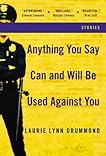 Anything You Say Can and Will Be Used Against You: Stories by Laurie Lynn Drummond
My rating: 4 of 5 stars
Delve into the brutal and contradictory world of these five female police officers, and you will find yourself simultaneously sympathetic and disturbed. Learn what life is like when your job is to help people in the most extreme situations and to be the first on the scenes of some of the most grisly crimes.
This kind of life can both save people and destroy relationships, and I found myself identifying with at least one thing about each of the main characters in these short stories. I wouldn't recommend reading it when you're already feeling upset about something, though--it is not light fare; it does not pull any punches.
View all my reviews
Thursday, July 23, 2009
Review - The Princess and the Goblin
 The Princess and the Goblin by George MacDonald
My rating: 4 of 5 stars
This was really an enjoyable read. George MacDonald was a fantasy writer and minister who lived from 1824-1905. To put his work into perspective, he followed closely on the heels of Hans Christian Andersen and helped to convince Lewis Carroll to publish his Alice stories. Although he is not as well known now, he also served as an inspiration for the next generation of fantasy writers (Lewis, Tolkien, L'Engle)--part of the sort of bridge between true fairy tales and the fantasy genre as we know it today.
In The Princess and the Goblin, the Princess Irene aids the miner boy Curdie in uncovering and foiling a wicked plot by the underground-dwelling goblins. A simple story, but beautifully written and full of magic.
As MacDonald was a Christian minister, his faith does imbue his stories with a sense of spirituality, but I found it to be more subtle than in Lewis' Narnia stories. The two children are aided by Princess Irene's mysterious great great grandmother, who can only be seen by those who believe she is there. Lots of connections to God in this character, particularly in the following touching scene:
The princess was so bewildered with astonishment and admiration that she could hardly thank her, and drew nigh with timidity, feeling dirty and uncomfortable. The lady was seated on a low chair by the side of the fire, with hands outstretched to take her, but the princess hung back with a troubled smile.
'Why, what's the matter?' asked her grandmother. 'You haven't been doing anything wrong—I know that by your face, though it is rather miserable. What's the matter, my dear?'
And she still held out her arms.
'Dear grandmother,' said Irene, 'I'm not so sure that I haven't done something wrong. I ought to have run up to you at once when the long-legged cat came in at the window, instead of running out on the mountain and making myself such a fright.'
'You were taken by surprise, my child, and you are not so likely to do it again. It is when people do wrong things wilfully that they are the more likely to do them again. Come.'
And still she held out her arms.
'But, grandmother, you're so beautiful and grand with your crown on; and I am so dirty with mud and rain! I should quite spoil your beautiful blue dress.'
With a merry little laugh the lady sprung from her chair, more lightly far than Irene herself could, caught the child to her bosom, and, kissing the tear-stained face over and over, sat down with her in her lap.
'Oh, grandmother! You'll make yourself such a mess!' cried Irene, clinging to her.
'You darling! do you think I care more for my dress than for my little girl?'
Anyway, wonderful story. You can read it online for free at Project Gutenberg--here is a direct link. They also have most of MacDonald's other stories since they are in the public domain. The book is followed by a sequel, The Princess and Curdie. Incidentally, there was also an animated movie of The Princess and the Goblin from 1992. I don't think I ever saw it since it looked pretty cheesy, but now I am intrigued to know whether it follows the book.
View all my reviews
Saturday, July 18, 2009
Review - Shadowlands
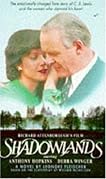 Shadowlands by Leonore Fleischer
My rating: 4 of 5 stars
To tell you the truth, I didn't expect much from a book that is a novel "based on the screenplay by William Nicholson based on his stage play." However, I was pleasantly surprised by the . . . joy of reading it! A few editing issues--a repeated paragraph here and there, etc. Other than that, however, the writing was smooth and vivid.
This book is based on the true story of C.S. Lewis' romance and marriage with Joy Davidman Gresham. Lewis, in his fifties and settled into the life of a university teacher and bachelor, thought that he knew what love was--until he realized, thanks to Joy, that he had been putting up walls to keep his feelings in and people out ever since his mother died when he was nine years old. Through his marriage to Joy, C.S. Lewis came alive again and was finally able to understand the wonder and the suffering that he had been lecturing about for so long.
Lewis' story resonated with me, as I have also been through a lot of pain in my life and a lot of effort to protect myself from it. Person by person and book by book, I catch glimpses of freedom through the holes in my own walls, making joyful connections to the other side. For, as the father of one of Lewis' students is reported in this story to have said, "We read to know that we're not alone."
View all my reviews
Subscribe to:
Posts (Atom)

